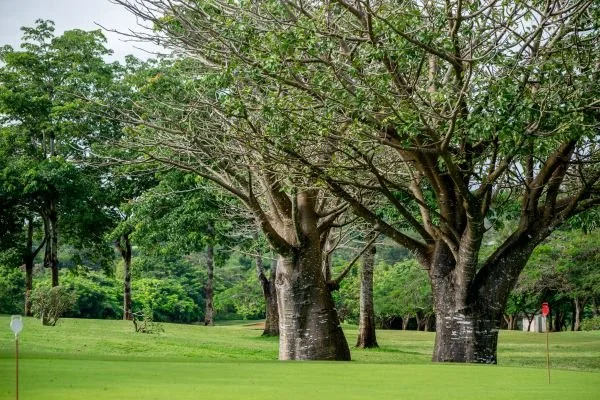
Beyond the fairways, gardens, coastal views and open spaces of Vipingo Ridge lies another important part of the destination’s story - a landscape where wildlife lives, moves, feeds and reproduces alongside the people who call this place home.
Vipingo Ridge is home to hundreds of species, from birds and reptiles to insects and native plants. In order to help educate and capture the imagination we are borrowing a concept from Magical Kenya and the people’s of Samburu, and adopting our own ‘Vipingo 5’. We hope by shining a spotlight and encouraging our homeowners and guests to see these Vipingo Ridge characters, that we increase the passion and enthusiasm for protecting these species.
The Vipingo 5 is a celebration of five distinctive species and individuals that represent the character of our Wildlife Sanctuary: the Wildebeest, Eland, Waterbuck, Reticulated Giraffe and Giant Tortoise.
Each has its own story. Some are recognised by their physical markings, others by their behaviour, and one by a name and personality that have made him particularly memorable. Together, they offer a glimpse into the biodiversity that makes Vipingo Ridge more than a lifestyle destination; it is also a place where wildlife has Space to Thrive.
As you explore Vipingo Ridge, keep your eyes open. You may encounter one of these remarkable residents in unexpected places, from the open savanna and woodland to the areas around the Chodari, Sundowner and even the Airstrip.
1. The Wildebeest
The wildebeest is one of the most recognisable antelopes of the African savanna, instantly identifiable by its powerful build, sloping back, broad muzzle and distinctive horns.
At Vipingo Ridge, the wildebeest population remains stable, providing an important part of the sanctuary's wildlife story as the only herd at the Kenya Coast. But beyond simply seeing them, understanding their behaviour reveals just how fascinating these animals are.
Life in the herd
Wildebeest are highly social animals. They generally live in fluid herds made up largely of females and their young, alongside a number of males. Their social structure is relatively peaceful for much of the year, but this changes dramatically during the breeding season, or rut.
During the rut, males establish territories and compete for access to females. Displays of strength, posturing and physical confrontations help determine dominance. What may appear to be an ordinary herd from a distance can therefore become a very different scene when breeding season arrives.
A carefully timed beginning
Wildebeest reproduction is closely linked to the rains and the resulting abundance of food. Following mating, a female carries her calf for approximately 8½ months, usually giving birth to a single calf.
One of the most remarkable aspects of wildebeest reproduction is the synchronisation of calving. When many calves are born within a relatively short period, the sheer number of young animals can improve their chances of surviving predation.
It is a powerful example of how timing and instinct work together in the wild.
How to recognise them
Individual wildebeest can be distinguished by observing:
Horn shape and structure
Body size and build
Scars or other distinctive markings
Individual behavioural traits
Males are generally larger and heavier than females and tend to have thicker, more substantial horns.
While the wildebeest at Vipingo Ridge are stable, wildebeest populations elsewhere face pressures including habitat loss, restricted movement caused by fencing, disruption of migratory routes and human-wildlife conflict.
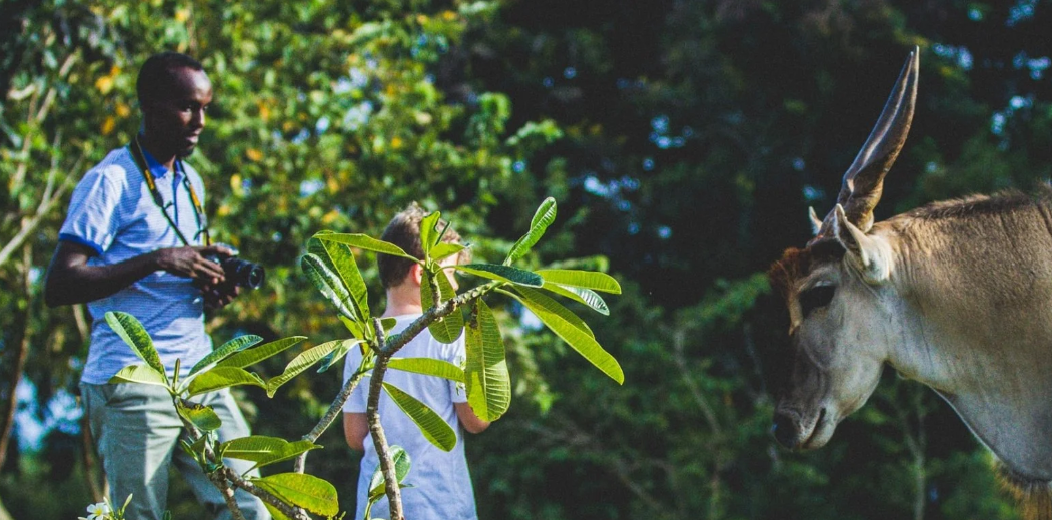
2. Tawi the Eland
Among the Vipingo 5, the eland has a particularly special story especially when you know Tawi.
Elands are among Africa's largest antelopes. They are powerful, graceful animals that can appear surprisingly gentle despite their impressive size.
Meet Tawi
Tawi is a male eland who grew up in a Zebra Sanctuary in Kenya, and his unusual upbringing has shaped where you are most likely to find him today.
When he became too big he was translocated to Tsavo East (not far from Vipingo Ridge), but as he had not seen predators before, he had no natural instincts or fear, so within a monitored 48 hours of his release, surrounded by lions, he was brought to Vipingo Ridge where he could contribute to the genetic diversity of the eland population and roam free in safety.
Look closely among the zebras and you may spot Tawi moving alongside them. His association with the zebra herd is one of the little details that makes wildlife watching at Vipingo Ridge so rewarding. He doesn’t generally spend time with the other eland of the Ridge.
He is not simply another eland to identify — he is an individual with a story: a Z-eland.
Understanding eland society
Elands live in social groups that can range from small family units to larger aggregations. Females generally live with their young, while males may spend time alone or form bachelor groups when they are not breeding.
As with many antelope species, breeding can change social dynamics, with males becoming more competitive as they establish dominance and seek mating opportunities.
How to identify an eland
When looking for Tawi, pay attention to:
The size and shape of his horns
His larger male body frame
His thicker neck
His pronounced dewlap
Any distinctive scars or markings
Most importantly his association with the zebras, and he also sports a fun tuft of hair, which has earnt him the nickname ‘Gorgeous George’ among some of our residents.
Elands at Vipingo Ridge are currently stable. Across their wider range, however, they face challenges including habitat loss, hunting and competition for resources with livestock.
Tawi reminds us that conservation is not only about species. It is also about the individual animals that develop their own histories and relationships within a protected landscape.
3. The Waterbuck
If there is one place to keep your eyes especially open for a waterbuck, it is around the Chodari Dam.
Waterbucks are large, robust antelopes that have adapted to life in habitats where water and lush vegetation are readily available. At Vipingo Ridge, the Chodari provides an ideal environment, offering both water and rich grazing opportunities.
Built for the savanna
Waterbucks have a shaggy brown-to-grey coat and one of their most distinctive features is the white ring around the rump.
Males are considerably larger than females and carry impressive, long, lyre-shaped horns that can reach approximately 40 inches in length.
A mature male can stand around 4.3 to 4.9 feet at the shoulder and weigh between approximately 440 and 660 pounds, while females are generally smaller.
Listen for them
Waterbucks communicate through a range of vocalisations, including grunts, snorts and whistles.
Their communication becomes particularly important when animals are maintaining social contact or responding to potential threats.
A grazer by nature
Waterbucks primarily graze on grasses. When grass is less abundant, they can also browse on leaves and other vegetation.
Their preference for areas with water and vegetation makes the Chodari and its surrounding habitat an important part of their daily lives.
Breeding and social behaviour
Waterbuck breeding is often associated with periods when food is plentiful. Dominant males establish territories and may gather groups of females, defending their access through displays and confrontations with competing males.
Following a gestation period of approximately eight months, a female typically gives birth to a single calf, often choosing a secluded location that offers protection from predators.
Outside breeding periods, males are commonly solitary or form bachelor groups, while females and their young form smaller herds.
The waterbuck population at Vipingo Ridge remains stable. Across its wider range, however, the species faces pressures from habitat loss, hunting and changing climatic conditions.
When spotting one, look for the white rump ring, shaggy coat and, in males, the distinctive lyre-shaped horns.
4. The Reticulated Giraffe
Standing above almost everything around them, giraffes are impossible to miss although they can sometimes disappear surprisingly well among the trees.
The reticulated giraffe is the tallest land animal at Vipingo Ridge and one of the most distinctive members of the Vipingo 5.
Today, our giraffe family consists of four individuals: Valentine, Chaa, Kampoe and Lunar.
Meet the Tower
Valentine is the only male and is the Alpha of the group. He can often be recognised by his size and stature.
Chaa is one of our females and is also the mother of Luna, born on a beautiful full moon night on the 1st of April, our youngest member.
Luna represents the next generation of giraffes at Vipingo Ridge, having been born to Chaa and becoming the latest addition to the group.
And then there is Kampoe, who is currently expected to give birth soon meaning the tower may soon become a little taller.
More than just a long neck
Giraffes can reach heights of approximately 16–18 feet for males and 14–16 feet for females.
Their reticulated coats are made up of rich tan-to-deep-brown patches separated by lighter lines. Their large expressive eyes, long eyelashes and small horn-like structures called ossicones add to their unmistakable appearance.
But perhaps the most remarkable feature is their ability to use their long, approximately 18-inch prehensile tongues to reach vegetation unavailable to many other herbivores.
Dining above the competition
Giraffes are browsers rather than grazers. They feed primarily on leaves, flowers and fruits from trees and shrubs, particularly acacias.
At Vipingo Ridge, their diet includes vegetation such as:
Sweet acacia
Leucaena
Indigophera
Solanum
Neem
Flagellaria
Cassytha
A giraffe can consume as much as 75 pounds of vegetation in a day, using its height and specialised anatomy to access food high above the ground.
Where to look
The giraffes favour savanna and open woodland, particularly around the Sundowner and Airstrip, where open spaces and tall trees provide ideal feeding areas.
They generally move together as a group, although individuals may sometimes wander off to feed independently.
A quiet language
Giraffes communicate in ways that are easy for humans to overlook. They can grunt, snort, hiss and produce low-frequency humming sounds that may be difficult for humans to hear.
These sounds can help maintain contact within the group and communicate potential danger.
The next generation
Giraffes can breed throughout the year rather than following one strict breeding season. Males may compete through dramatic necking contests, swinging their powerful necks and heads against one another to establish dominance.
After approximately 15 months of gestation, a female generally gives birth to a single calf.
With Kampoe expected to give birth, the story of Vipingo Ridge's giraffes is continuing to unfold one generation at a time.
Giraffes are classified globally as Vulnerable, with habitat loss, poaching and human-wildlife conflict among the pressures affecting populations. At Vipingo Ridge, protecting habitat and monitoring the population form an important part of our commitment to giving wildlife space to thrive.
And when you see a giraffe, look carefully. Their coat patterns are unique, allowing individual animals to be identified. Valentine is readily recognisable, while the females can be distinguished through differences in height, coat shade and individual markings, including a scar on one female's front limb.
It is important to know that Chaa and Valentine were rescued from a prolonged drought in Samburu and relocated from Reteti Conservancy in Samburu to Vipingo Ridge by the Kenya Wildlife Services five years ago.
5. Alexander the Great
The final member of the Vipingo 5 does not have horns, stripes or a towering neck.
He has something else: time.
Meet Alexander the Great, Vipingo Ridge's Giant Tortoise.
Alexander is a Giant Tortoise of Seychelles origin, belonging to the Aldabrachelys group. He is estimated to be between 40 and 50 years old and is considered to be in the prime of his life. Giant tortoises are among the world's longest-lived animals, with some individuals believed to live for more than 200 years.
A new chapter
Alexander arrived at Vipingo Ridge following a carefully coordinated relocation involving his former family, conservationists, the Kenya Wildlife Service and the Vipingo Ridge conservation team.
He had been part of a family for around four decades before relocating to Vipingo Ridge, where the expansive protected environment could provide the space and long-term care he needed.
His arrival marked another chapter in Vipingo Ridge's conservation journey and followed the site's development as a licensed Wildlife Sanctuary in 2020, working with conservation partners including KWS.
Getting to know Alexander
Alexander is already developing a reputation as one of the sanctuary's most memorable residents. He is known to respond to his name and has a particular fondness for watermelon during warmer months.
As he settles into his new environment, the Ranger team continues to observe his routines and behaviour, learning more about his preferences and ensuring that his new home supports his long-term wellbeing.
For now, Alexander has a dedicated boma within the Sports Club area, giving him a secure environment as he acclimatises. There are plans to understand his movements further through tracking and observation before potentially expanding his roaming space.
A resident to admire
Alexander may appear calm and approachable, but he remains a wild animal and should be treated accordingly.
Visitors are reminded that he should not be ridden, petted or hand-fed. Any food donations should be coordinated through the Ranger team rather than offered directly to him.
His story is an important reminder that conservation is also about creating safe, respectful relationships between people and wildlife.
More Than Five Animals. Five Stories.
The Vipingo 5 are more than a collection of species.
They represent adaptation, family, instinct, individuality and conservation.
The wildebeest demonstrates the strength of herd life and the importance of timing.
Tawi the eland reminds us that individual animals can form unexpected associations and develop their own stories. The waterbuck reflects the importance of water and healthy habitats.
The giraffe family represents continuity and the arrival of a new generation.
And Alexander the Great reminds us that conservation can give an animal a new chapter- even after decades of life elsewhere.
These stories are unfolding every day across Vipingo Ridge.
So the next time you are out on the course, walking through the estate, enjoying the Sundowner or exploring the sanctuary, take a moment to look beyond the landscape.
You may just meet one of the Vipingo 5.
A respectful encounter
Wildlife watching is most rewarding when animals remain wild. Please observe from a respectful distance, avoid feeding or touching wildlife, and allow animals to move freely through their habitat.
The sanctuary is their home.
More Wildlife and Conservation Blogs: